
ORL, critères d’extension tumorale extra ganglionnaire des métastases ganglionnaires des carcinomes : accordons nos violons.
Dans cet article de veille scientifique, François Bidault présente les enjeux liés à l’extension tumorale extraganglionnaire des métastases ganglionnaires en ORL. Facteur pronostique essentiel, elle fait désormais l’objet d’un consensus international visant à harmoniser les critères radiologiques et à renforcer la cohérence des comptes-rendus et des études cliniques.
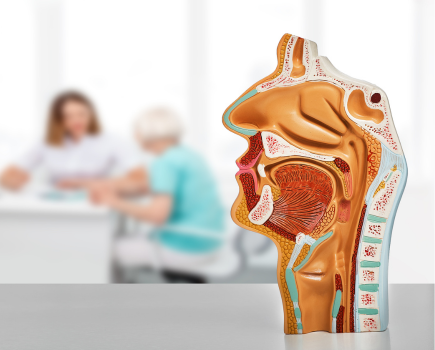
Les carcinomes épidermoïdes des muqueuses des voies aérodigestives supérieures métastasent fréquemment aux ganglions cervicaux. L’extension tumorale extraganglionnaire, c’est-à-dire au-delà les limites périphériques du ganglion, est un facteur pronostic péjoratif pris en compte dans la classification TNM à partir de sa version 8. L’histologie, l’imagerie et l’examen clinique observent les extensions tumorales extraganglionnaires à des échelles différentes. Les petites effractions histologiques de la capsule ganglionnaire peuvent être difficiles à repérer cliniquement ou par imagerie. Des méta-analyses rapportent déjà les performances des imageries pour la recherche des extensions tumorales extraganglionnaires (cf pour aller plus loin). Quelle que soit la performance de l’imagerie comparée à celle de l’anatompathologie ou de la clinique, un consensus semble utile pour rapporter la sémiologie « radiologique » de l’extension extraganglionnaire dans les comptes-rendus des examens.
C’est ce que propose un groupe international dans la publication de Henson C et collègues dans Lancet Oncology. Le consensus proposé décrit clairement comment rapporter une extension tumorale extraganglionnaire dans un compte-rendu d’imagerie. La grille de lecture proposée par le consensus doit toutefois être testée quant à la concordance inter observateurs sur une collection d’images ganglionnaires cervicales. Les résultats de ce travail complémentaire devraient être disponibles courant 2025.
Référence
Henson C , Abou-Foul A , Yu E , et al.
Criteria for the diagnosis of extranodal extension detected on radiological imaging in head and neck cancer: Head and Neck Cancer International Group consensus recommendations.
Lancet Oncol. 2024 Jul;25(7):e297-e307. doi: 10.1016/S1470-2045(24)00066-4
Références complémentaires pour aller plus loin
Abdel-Halim C, Rosenberg T, Dyrvig A, et al. Oral Oncology 114 (2021) 105169.
Diagnostic accuracy of imaging modalities in detection of histopathological extranodal extension: A systematic review and meta-analysis.
Park S, Guenette J, Suh C et al. European Radiology (2021) 31:2048–2061.
The diagnostic performance of CT and MRI for detecting extranodal extension in patients with head and neck squamous cell carcinoma: a systematic review and diagnostic meta-analysis.